
 +84902267398
 Table of Contents
PP Filler Masterbatch plays a critical role in the highly competitive PP woven industry, where optimizing material costs without sacrificing tape strength is the ultimate goal. However, utilizing sub-standard fillers often results in severe operational headaches, from frequent tape breakage to persistent water carry-over. To solve this, Mega Plast has engineered a specialized PP Filler Masterbatch that allows high-speed extrusion lines to achieve maximum loading rates and true cost savings. Here is exactly how we do it.
1. PP Woven — The Most Demanding Application for Filler Masterbatch
In the global plastics industry, the production of PP woven bags and sacks is widely recognized as one of the most technically demanding applications. Today’s modern flat yarn extrusion lines are engineered to operate at incredibly high velocities, typically ranging from 300 to over 600 meters per minute.
At this breakneck speed, the margin for error is practically zero. The process requires the Filler Masterbatch to possess absolute and flawless dispersion. Just a microscopic cluster of low-quality CaCO3 Powder agglomerated in the polymer matrix will instantly create a weak point. This inevitably causes tape breakage, leading to forced machine downtime, severe production interruptions, and immediate financial losses.
To combat this industry-wide challenge, Mega Plast has developed a specialized PP Filler Masterbatch utilizing ultra-fine CaCO3 Powder. By guaranteeing flawless dispersion, our masterbatch ensures that your high-speed lines run continuously without interruption, right from the very first batch.
2. Why Leading PP Woven Producers Always Prioritize Mega Plast’s Premium Filler Masterbatch
Many plant managers mistakenly believe that sourcing the absolute cheapest filler is the best way to reduce packaging costs. In reality, evaluating raw materials based solely on upfront price creates a dangerous false economy. Our partners at Mega Plast understand that true optimization goes far beyond the initial price tag:
Tape Strength is a Commercial Commitment
End-buyers in the agricultural and construction sectors demand absolute tensile strength. Using a poor-quality filler compromises the mechanical properties of the tape, resulting in rejected shipments. Mega Plast’s highly compatible formulations ensure your tape strength remains robust, even at high dosing ratios.
True Savings Come From a Stable Loading Rate
Manufacturers cannot push the loading rate higher if the filler quality is inconsistent. A premium, finely engineered filler allows extrusion lines to safely run at higher ratios without breaking the tape, yielding genuine, long-term cost optimization.
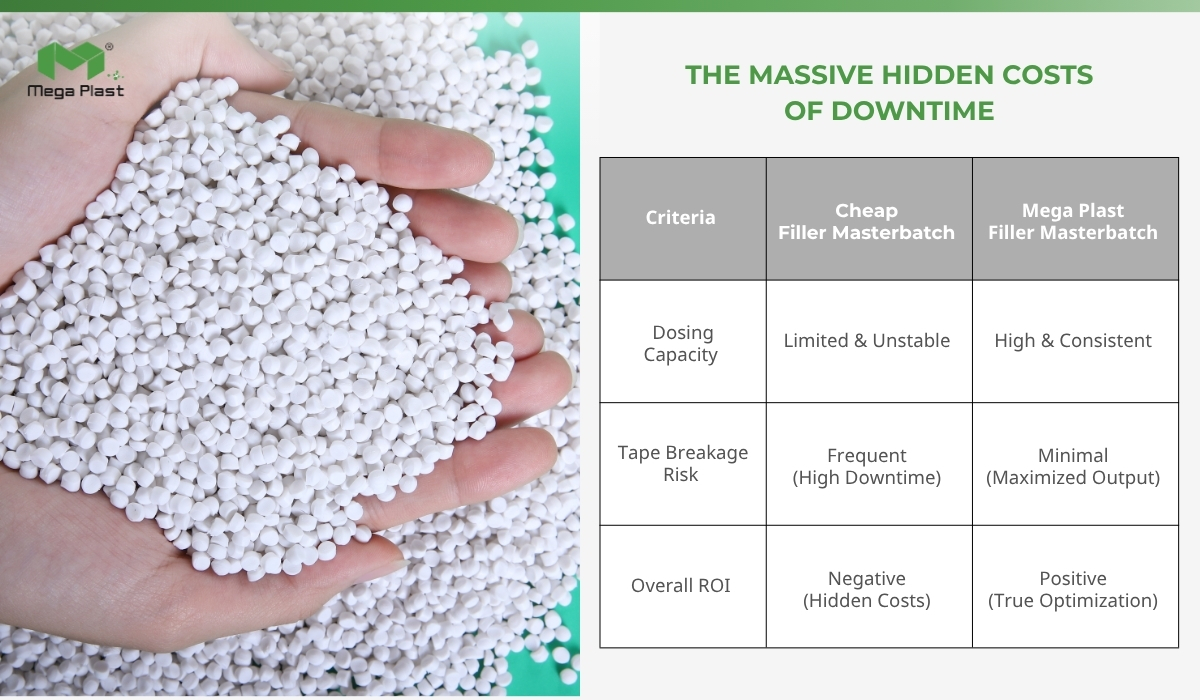
The Massive Hidden Costs of Downtime
The financial impact of a single hour of machine downtime, tape splicing, and the resulting scrap material is exponentially higher than the monthly savings generated by purchasing a cheaper filler. Buying inferior resin additives but suffering high tape breakage rates means the factory’s Return on Investment (ROI) is effectively negative.
3. The Loading Rate — The Ultimate Cost Lever
The loading rate refers to the exact percentage of Filler Masterbatch blended with the virgin PP resin. Mastering this ratio is the single most important lever for reducing overall production costs.
Comparing 20% vs. 25% vs. 30% Loading Rates: When a factory successfully increases its loading rate from 20% to 30%, raw material expenditures drop significantly. However, the risk of film tearing and tape breakage also increases exponentially if the filler is not manufactured to strict standards.
The maximum loading rate an extrusion line can handle safely depends on four crucial factors:
- Average Particle Size (D50 index): Finer particles integrate more seamlessly into the PP matrix.
- Surface Coating Quality: Proper chemical coating ensures the mineral does not separate from the plastic under high stress.
- Tensile Strength Requirements: Heavier duty bags require specialized formulations to maintain elongation properties.
- Extruder Operating Speed: Higher speeds demand superior melt flow and dispersion.
4. High-Speed Extrusion: 3 Common Problems & The Mega Plast Solutions
If a PP woven facility is experiencing continuous operational bottlenecks, the root cause is very likely an incompatible or low-grade filler. Here is how Mega Plast eliminates the three most common high-speed extrusion problems:
Problem 1: Frequent Tape Breakage
- The Cause: Agglomerated CaCO3 Powder particles create localized “stress concentration points” on the ultra-thin film, causing it to snap in the orientation oven.
- The Mega Plast Fix: We utilize advanced triple-screw extrusion technology. This guarantees the absolute, flawless dispersion of the powder, entirely eliminating agglomeration.
Problem 2: Severe Water Carry-Over
- The Cause: Excessive moisture rapidly evaporates at the extrusion die, carrying condensed water onto the film surface and ruining its structural integrity.
- The Mega Plast Fix: Our strict in-house quality control ensures an ultra-low moisture percentage, permanently eliminating water carry-over risks.
Problem 3: Unexplained Speed Reduction
- The Cause: An incompatible Melt Flow Index (MFI) increases die head pressure, forcing operators to manually reduce the line speed.
- The Mega Plast Fix: Our R&D lab custom-engineers the MFI of our filler to perfectly match your specific PP carrier resin, ensuring smooth, high-speed operability.
5. The Expert Checklist: 5 Criteria for Choosing the Right PP Filler Masterbatch
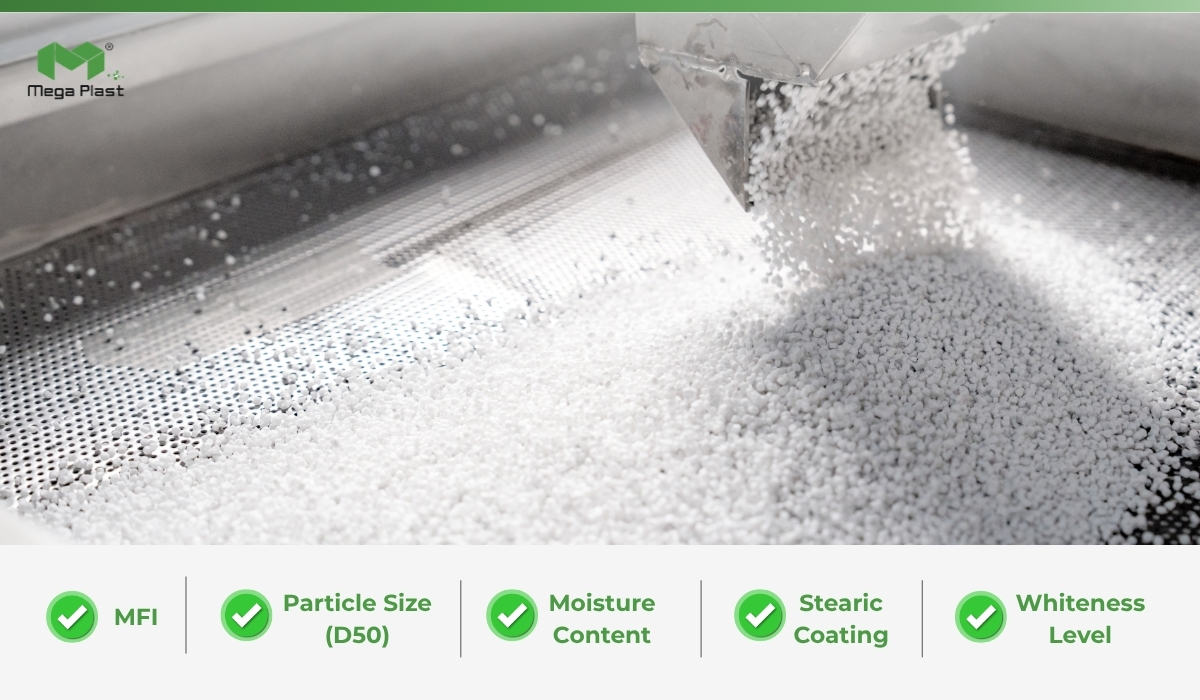
Savvy procurement managers do not rely on price tags alone; they rigorously analyze the Technical Data Sheet (TDS). When evaluating Mega Plast’s specifications against competitors, always check these 5 critical criteria:
- Melt Flow Index (MFI): The filler’s MFI must be scientifically formulated to match the specific PP base resin used in the factory to ensure uniform melting.
- Particle Size (D50): The calcium carbonate powder must be ultra-fine (typically < 2µm) to prevent film scratching and guarantee smooth drawing.
- Moisture Content: Moisture levels must be strictly controlled to an ultra-low percentage to permanently eliminate water carry-over risks.
- Stearic Coating: CaCO3 particles must be completely treated with a premium stearic acid coating for flawless dispersion into the polymer structure.
- Whiteness Level: High natural whiteness allows manufacturers to save significant capital by reducing the need for additional White Masterbatch.
6. Test Before You Commit: Optimize Your Factory Today
We do not expect plant managers to base their decisions on promises alone. Let your high-speed extrusion lines be the ultimate judge of our quality.
By partnering with Mega Plast, you are not just selecting a raw material supplier; you are integrating a high-performance manufacturing powerhouse into your supply chain. As a core member of the Nhat Huy Group, Mega Plast combines 22 years of manufacturing expertise with a massive export footprint, currently serving partners across 60+ countries worldwide.
Let us help you eliminate the guesswork in your procurement. We invite you to run a side-by-side trial to compare the dispersion, mechanical strength, and cost-efficiency of our masterbatch against your current source.
👇 Contact the Mega Plast Technical Team today to request your Free Sample, run a live trial, and safely maximize the loading rate for your factory!
Keep you up to date with us on Linkedin