
 +84902267398
 For Plant Managers and R&D Directors overseeing flexible packaging production, the daily pressure to reduce virgin resin consumption is intense. The most strategic solution in the market today is utilizing a high-performance Filler Masterbatch Blown Film. When formulated correctly, this compound acts not just as a cost-reducer, but as a multifunctional Blown Film Additive that actively optimizes the extrusion process.
However, experienced extrusion engineers know the harsh reality: the margin between “saving costs” and “crashing the line” is fragile. Feeding the wrong additive into your machine can instantly compromise the Blown Film bubble. So, how can you maximize your loading rate while keeping your extrusion line running at peak efficiency?
The Strategic Role of Filler Masterbatch in Blown Film
Before analyzing the mechanical risks of extrusion, it is crucial to understand why manufacturers integrate a filler masterbatch blown film into their formulations in the first place.
Primarily, it serves as a powerful economic tool. By replacing a significant percentage of costly virgin polymers (such as LLDPE, LDPE, or HDPE) with high-purity calcium carbonate (CaCO3 Powder), factories can drastically lower their overall raw material expenses.
However, cost reduction is only half the story. A compound acts as a vital blown film additive that enhances the physical properties of the final product. It increases the mechanical stiffness of the film (ideal for shopping bags and garbage liners), creates a micro-rough surface for superior ink printability, and introduces better thermal conductivity to the polymer matrix.
The Extrusion Reality: Pass vs. Fail on the Production Line
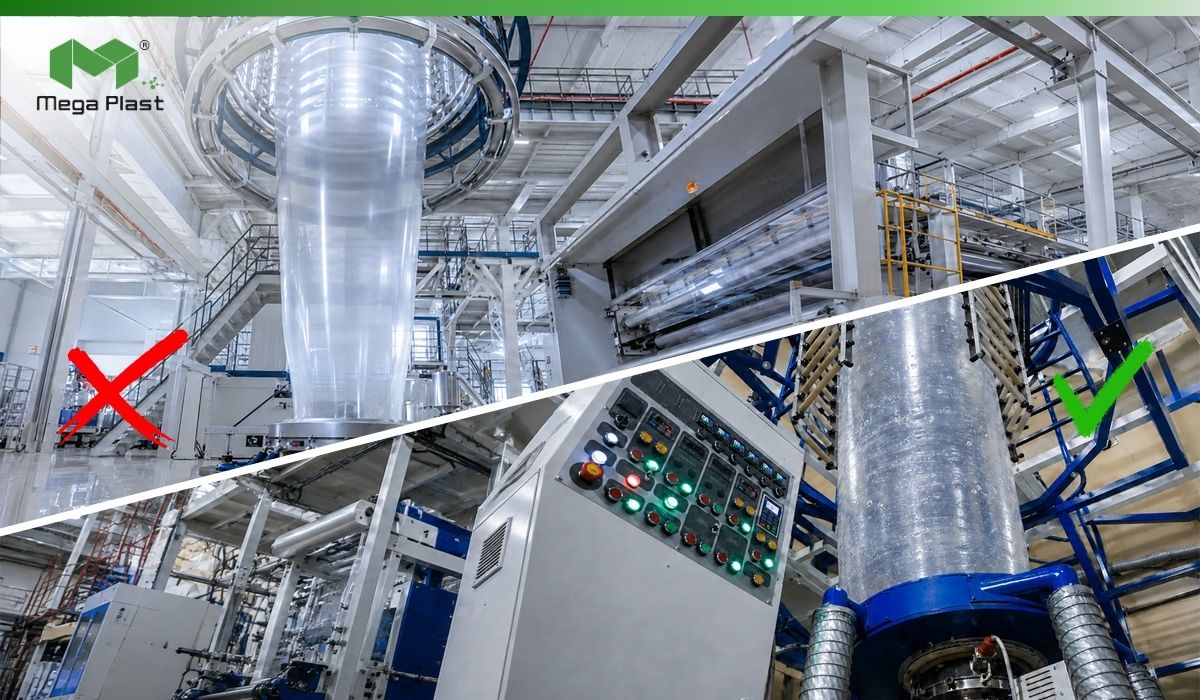
Blown film lines are incredibly sensitive to physical impurities and thermodynamic shifts. When you introduce a Filler Masterbatch Blown Film into the melt flow, here is what determines the success or failure of your production run:
The “FAIL” State:
If you use a poorly formulated Blown Film Additive, the delicate mechanics of the Blown Film bubble will collapse.
- Bubble Instability & Micro-voids: Natural limestone retains moisture. If the Filler Masterbatch lacks advanced drying treatments, moisture vaporizes at extrusion temperatures, creating micro-voids. This causes the film bubble to collapse, resulting in severe gauge variations.
- Die Drool & Screen Pack Blocking: Inconsistent D50 particle sizing and poor coating cause the minerals to agglomerate. These clumps not only create “fish-eyes” but also accumulate at the die lip (die drool) or block the screen packs, forcing you to halt the machine for cleaning.
The “PASS” State:
A high-quality Filler Masterbatch Blown Film blends seamlessly into the polymer matrix (LLDPE/LDPE/HDPE). The bubble remains rigid and stable, the gauge thickness is uniform, the die lip stays clean, and the final film exhibits a flawless, glossy finish with absolutely zero water carry-over.
The Mega Plast Difference: A Pure and Stable Blown Film Additive
Understanding the strict mechanical tolerances of extrusion lines, Mega Plast engineers Filler Masterbatch Blown Film solutions that guarantee absolute peace of mind for R&D teams:
- Strict <0.1% Moisture Control: Every lot is rigorously lab-tested. Ultra-low moisture reduces the risk of water vapor expanding in the die, securing total bubble stability even at high loading rates.
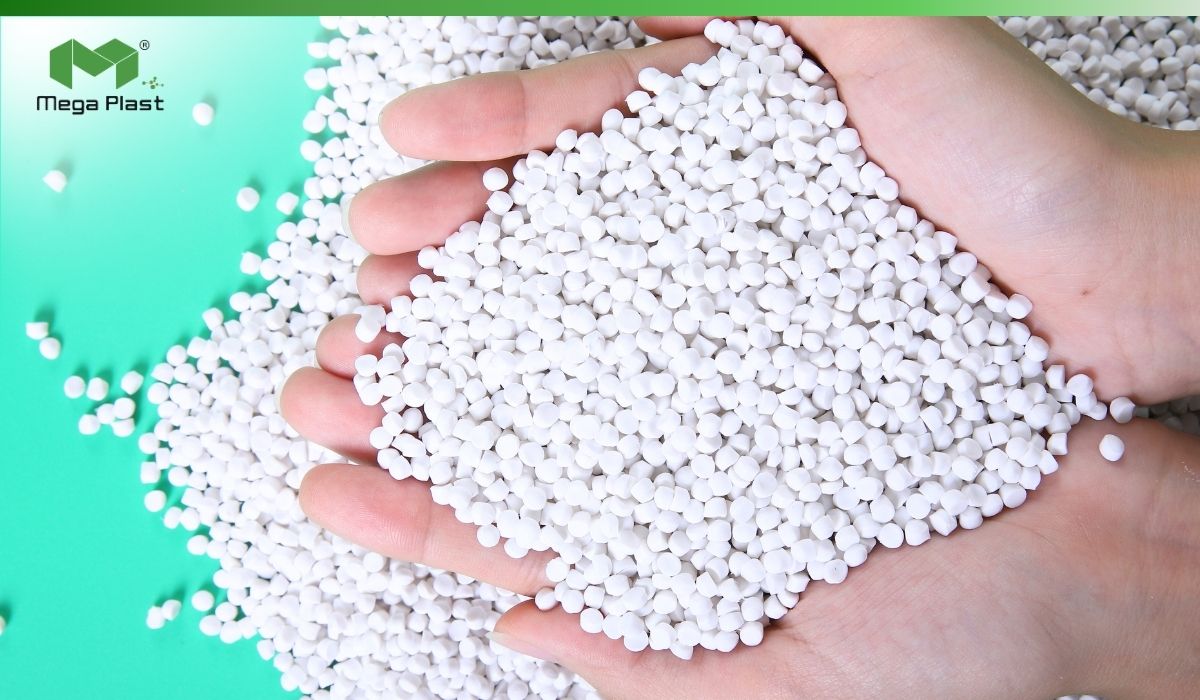
- Good Dispersion: Leveraging advanced milling technology, we strictly control the ultra-fine D50 particle size with uniform stearic acid coating. The Filler Masterbatch Blown Film prevents agglomeration, die drool and “fish-eyes”.
- Top-Tier Whiteness: Through our self-control materials(CaCO3 Powder) in Vietnam (Whiteness >98%), our Filler Masterbatch Blown Film delivers a premium white base, significantly lowering the need for costly TiO2.
Thermodynamic Optimization and Increased Line Speed
When used as an advanced Blown Film Additive, CaCO3 Powder provides a massive mechanical advantage: High Thermal Conductivity.
A polymer matrix loaded with CaCO3 Powder conducts and releases heat much faster than pure virgin resin. Consequently, the film bubble cools down more rapidly as it reaches the frost line.
This rapid cooling cycle allows plant managers to safely increase the haul-off speed (line speed) and boost overall production output without causing film blocking. Furthermore, it enhances the mechanical stiffness of the film, making bags easier to print and open.
Custom Formulation Matched to Your Extrusion Line
No two blown film setups share the exact same screw design or temperature profile. That is why Mega Plast does not sell generic, one-size-fits-all Filler Masterbatch. Our engineering team meticulously analyzes your system to customize the Melt Flow Index (MFI) and Carrier Resin.
Backed by 22 years of industry excellence, Mega Plast (a core member of Nhat Huy Group) is Vietnam’s premier masterbatch manufacturer. Operating 2 state-of-the-art factories equipped with 12 fully automated production lines, we deliver a massive output capacity of 30,000 MTS per month. By exporting to over 60 countries globally and utilizing our self-owned limestone quarries, we guarantee absolute lot-to-lot consistency and an unbreakable supply chain for your manufacturing facility.
Are you ready to safely increase your loading rate without battling operational risks? Stop guessing and let the technical data prove it.
👉 Message us your current Blown Film application details via WhatsApp: +84 902 267 398. Mega Plast’s R&D team will immediately send you the Technical Data Sheet (TDS) for the Filler Masterbatch Blown Film perfectly matched to your machinery.