
 +84902267398
For Plant Managers and Procurement Directors in the industrial packaging sector, PP Woven Bag Production cost optimization is a daily mandate. Whether your facility produces heavy-duty FIBCs, cement sacks, or agricultural packaging, the pressure to maintain healthy profit margins is immense. With virgin Polypropylene (PP) resin prices heavily influenced by volatile global petrochemical markets and freight costs constantly fluctuating, substituting base polymers with CaCO3 Filler Masterbatch is now standard practice.
However, executing this substitution successfully is more complex than it appears. Many manufacturers fall into a common procurement trap: they select a filler on invoice price alone, without checking whether it was engineered for raffia tape, and later face machine downtime, high scrap rates, and rising maintenance costs.
True PP Woven Bag Production cost optimization is not about the lowest price per ton; it is about lowering the total Cost-per-Bag through stable, efficient extrusion.
Where Cost Savings Disappear in PP Woven Bag Production
Before improving PP Woven Bag Production costs, manufacturers must identify where their operations are silently leaking profit. A filler that is not built for raffia extrusion creates operational bottlenecks that quietly wipe out the material savings you gained on paper:
- Tape Breakage & Machine Downtime: A filler without controlled moisture carries water into the process. When natural limestone holding excessive moisture enters an extruder barrel operating above 200°C, the trapped water flashes into steam. This sudden expansion creates microscopic voids (micro-voids) within the polymer matrix. As the PP tape is stretched, these voids act as stress concentrators, causing the tape to snap. Every single minute your high-speed circular looms sit idle due to tape breakage, your labor and overhead costs increase while output drops.
- Dust Generation & Mechanical Wear: When CaCO3 particles are unevenly sized or poorly dispersed, they do not bond into the PP matrix. During the high-friction weaving process, these loose mineral particles separate, generating excessive chalking and white dust. This dust settles on the machinery, clogging optical sensors, fouling yarn guides, and demanding frequent maintenance stops.
The Concept of “Cost-in-Use” vs. “Invoice Price”
To achieve genuine cost optimization in PP Woven Bag production, procurement teams must shift their focus from the “Invoice Price” to the “Cost-in-Use.”
Imagine comparing two Filler Masterbatches. Option A costs less per ton but causes instability, holding your loading rate down. Option B is a higher grade that costs slightly more upfront but features optimized dispersion and moisture control, letting your engineers raise the loading rate to the level your line can sustain. We recommend the rate per grade after a trial run on your own machine.
Because Option B displaces a larger volume of expensive virgin PP resin, the overall material cost for every PP woven bag produced drops. The higher grade yields a better ROI by enabling higher substitution rates without compromising mechanical integrity.
Technical Strategies for Safe Loading Rate Expansion
Scaling up your Filler ratio requires an engineered PP Woven Filler Masterbatch built to handle the rigorous demands of raffia tape extrusion. Here is the technical criteria required for a safe optimization strategy:
- Moisture max 0.1%: Controlled drying and compounding keep moisture in the filler masterbatch at or below 0.1%. This reduces water carry-over in the cooling bath and keeps your stretching line running.
- Optimized CaCO3 D50 Particle Dispersion: With CaCO3 D50 controlled at 1–3 µ and even dispersion, the particles blend into the PP matrix. This prevents agglomerates from accumulating at the die lip (a phenomenon known as “die drool”) and preserves the tape strength needed for FIBCs.
- Precise Melt Flow Index (MFI) Alignment: An optimized filler must have an MFI that closely matches your base PP resin. This alignment ensures a homogenous melt, stable bubble formation (if applicable), and consistent tape thickness across the entire production run. Our PP Woven grades (W202 / W282 / W262) run at MFI 5–7 g/10 min (2.16 kg / 230°C), which sits in the working range of standard raffia-grade PP.
Beyond Cost: Enhancing Physical Properties
A Filler Masterbatch acts as a multi-functional additive. Incorporating an engineered CaCO3 Filler Masterbatch into your woven bags introduces a further advantage.
- Enhanced Printability: The micro-porous nature of a well-dispersed calcium carbonate filler significantly improves ink adhesion. Following corona treatment, the surface allows for sharper, more durable printing, elevating the final brand presentation of the sack.
To dive deeper into how precise moisture control and dispersion prevent mechanical failures on your looms, read our core guide: https://megaplast.com.vn/news/pp-woven-filler-masterbatch-tape-breakage/
The Mega Plast Advantage: Direct Manufacturer Pricing
Beyond technical formulation, the structure of your supply chain plays a large role in material pricing. Purchasing through multi-layered trading companies adds unnecessary markups to your raw materials.
Backed by over 22 years of industry excellence from Nhat Huy Group, Mega Plast controls the entire production ecosystem. By controlling our own CaCO3 powder supply from group-owned limestone quarries and operating two compounding factories with 12 production lines, we eliminate third-party inefficiencies.
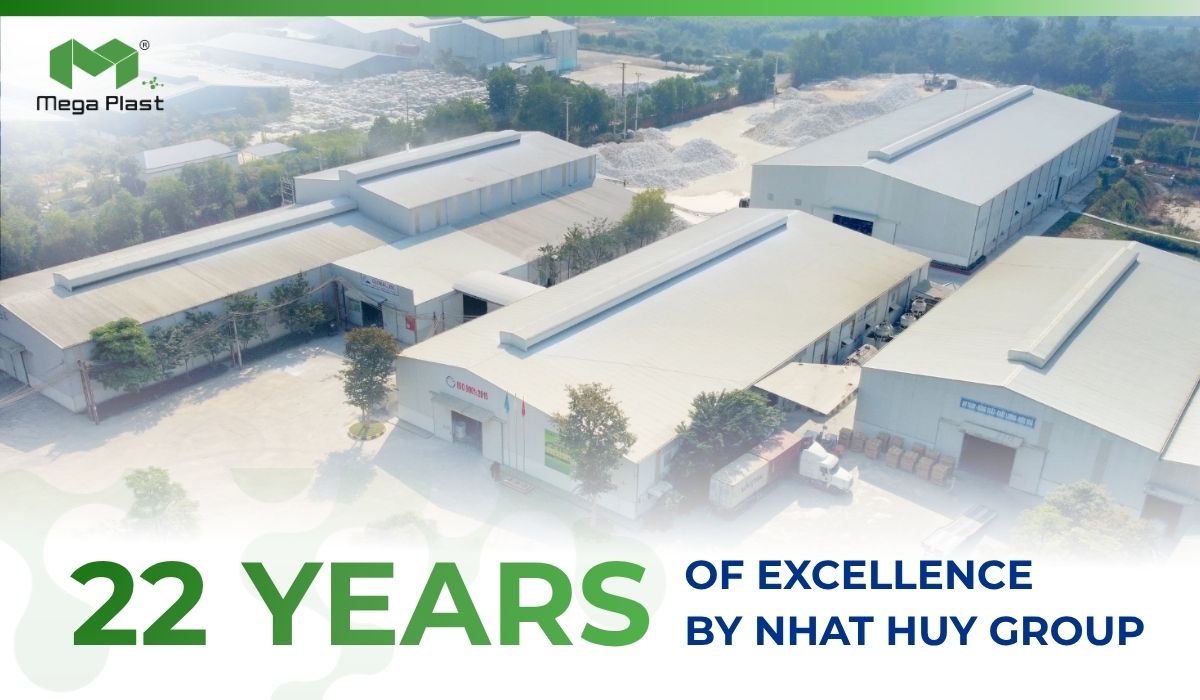
We pass this structural cost advantage directly to you, providing a factory-direct price for a technical grade. Furthermore, our global logistics network ensures steady supply chain security to over 60 countries.
Ready to evaluate the financial impact on your own extrusion lines? Stop relying on trial-and-error formulations and let the data prove the value. Contact Mega Plast’s engineering team via WhatsApp: +84 902 267 398 today to receive a customized Technical Data Sheet (TDS) and a direct cost-comparison quote tailored to your specific machinery.